

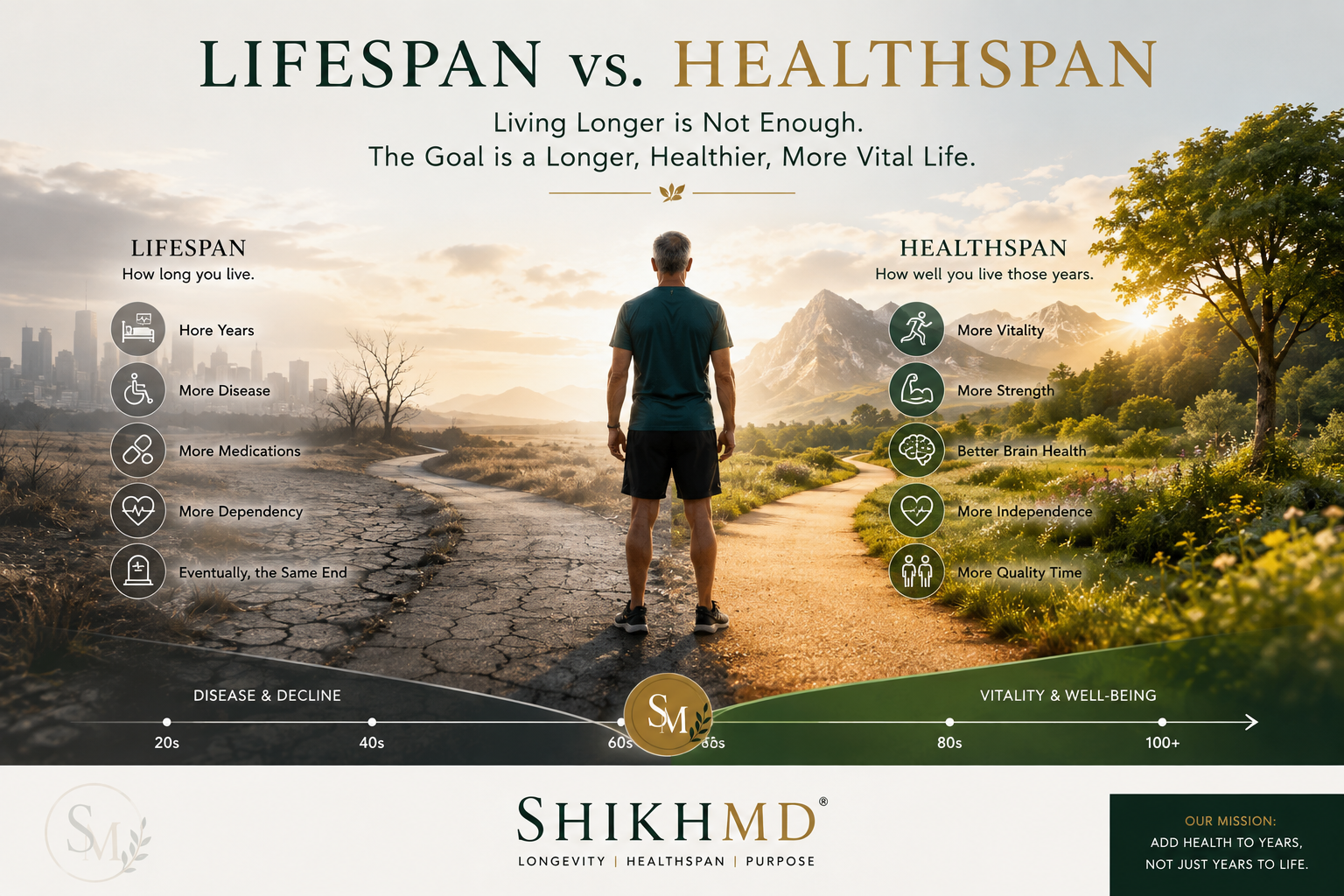
Lifespan tells you how long a person lives. Healthspan tells you how much of that life remains strong, clear, capable, and independent.
The healthspan gap
Modern medicine has extended life. People now routinely survive infections, injuries, cardiovascular events, and chronic diseases that once shortened life dramatically.
But survival and vitality are not the same. A person may live into older age while gradually losing strength, mobility, energy, cognitive clarity, confidence, intimacy, and independence. The years continue, but the usable life inside them narrows.
That distance between total years lived and years lived with good function is the healthspan gap.
Why lifespan alone is not enough
A longer life is valuable only if the added years remain sufficiently usable. The deeper goal is not simply postponing death. It is delaying the period of managed decline and preserving the capacity to participate fully in life.
This means protecting:
- physical strength and mobility,
- mental clarity,
- metabolic stability,
- emotional resilience,
- social connection,
- and independence.
What healthspan looks like in ordinary life
Healthspan is not an abstract laboratory concept. It is visible in daily function.
- Can you climb stairs without fear?
- Can you carry groceries, luggage, or a grandchild?
- Can you recover after travel, illness, or a poor night of sleep?
- Can you think clearly through a demanding day?
- Can you remain socially engaged and physically confident?
These are not softer substitutes for medical measurements. They are the lived outcomes those measurements are meant to protect.
Aging usually narrows before it disables
The healthspan gap often begins quietly. Recovery takes longer. Sleep becomes less restorative. Abdominal weight increases. Strength and aerobic capacity decline. Balance becomes less automatic. A person begins avoiding activities that once felt routine.
None of these changes alone necessarily represents disease. Together, they may signal that reserve is shrinking and burden is increasing.
Reserve is the margin that keeps life wide
Reserve is the difference between what life demands and what the body can handle. When reserve is high, ordinary tasks consume only a small portion of capacity. When reserve is low, stairs, travel, stress, illness, or a disrupted night can consume nearly everything available.
Healthspan improves when that margin widens again.
The goal is compression of morbidity
The practical aspiration is to postpone disability and major functional decline as long as possible, so that the period of illness and dependence occupies a smaller portion of the total lifespan.
That does not mean denying aging. It means influencing its trajectory through earlier recognition, prevention, and reserve-building.
What determines healthspan?
Healthspan is shaped by many interacting factors:
- genetics and family history,
- blood pressure and vascular health,
- metabolic health,
- muscle and aerobic capacity,
- sleep and recovery,
- nutrition,
- smoking and alcohol exposure,
- stress, relationships, and purpose,
- and access to preventive care.
Not every factor is controllable. Many are modifiable enough to matter.
How to define your own healthspan target
Start with function rather than fear. Ask what you want to remain able to do at age 80 or 85.
Your target might be:
- traveling independently,
- playing with grandchildren,
- continuing meaningful work,
- walking several miles,
- living without assistance,
- or maintaining enough strength and clarity to make your own decisions.
That future function becomes the reason to act earlier today.
What to do next
Identify the domains most likely to narrow your future healthspan. That may be uncontrolled blood pressure, poor sleep, inactivity, low muscle mass, central weight gain, smoking, social isolation, or a strong family history of disease.
A useful plan then addresses the highest-impact risks in an order that can be sustained.
This article provides general educational information and is not a substitute for individualized medical diagnosis or treatment.
From the ShikhMD Library
Continue in Built to Last: The Longevity Blueprint
Source chapters: The New Longevity; The Longevity Blueprint Framework.
Explore the bookMedical disclaimer: This article provides general educational information and is not a substitute for individualized medical diagnosis or treatment.