

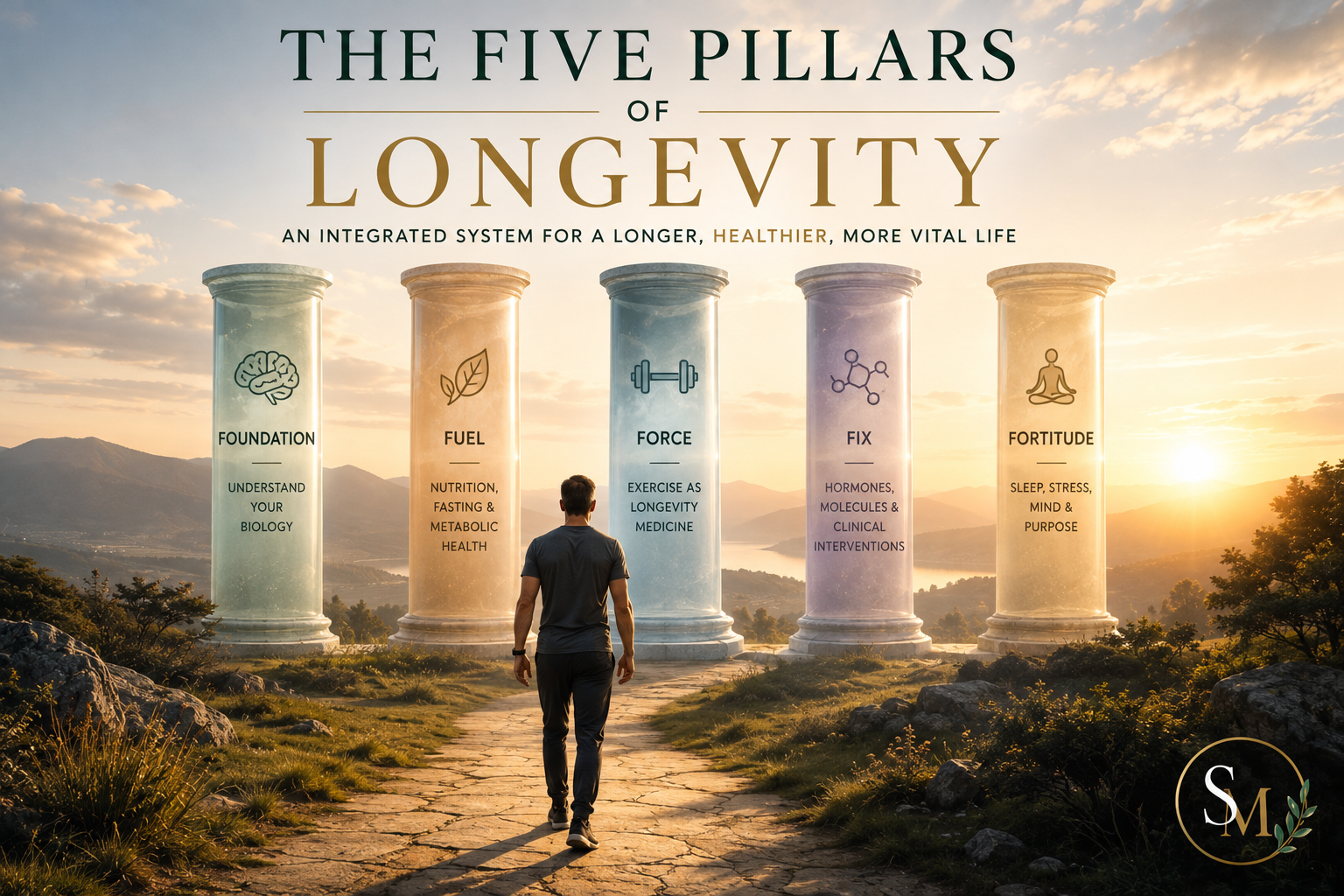
Healthy aging is a system, not a collection of disconnected habits. Sleep, nutrition, blood pressure, exercise, stress, weight, and clinical care all influence one another. Without an organizing framework, even good intentions become difficult to sustain.
Why a framework matters
Most people do not fail because they lack motivation. They fail because the plan they are following has no architecture. A habit added in isolation is easy to abandon. A habit connected to a larger system is easier to understand, protect, and improve.
The Five Pillars of Longevity give every major decision a place: what to measure, what to eat, how to move, when to use clinical tools, and how to recover well enough for any of it to work.
Reserve and burden: the two forces underneath the pillars
Reserve is the body’s and mind’s capacity to tolerate stress, illness, disruption, and the ordinary demands of life without disproportionate decline.
Burden is everything the body is being asked to carry: poor sleep, central fat, chronic stress, processed food, smoking, isolation, or medications that are no longer being meaningfully reviewed.
The longevity project is to increase reserve while reducing burden. The five pillars provide the structure for doing both at the same time.
Pillar 1: Foundation — Understanding Your Biology
Core principle: data before action.
Before adding interventions, understand your baseline. Know your major risks, family history, blood pressure, metabolic markers, cardiovascular profile, body composition, fitness, sleep quality, and functional capacity.
Foundation is not about collecting every possible test. It is about identifying the few measurements that clarify what matters most and what should happen next.
Pillar 2: Fuel — Nutrition, Fasting, and Metabolic Health
Core principle: food is biological information.
What and when you eat influence glucose regulation, body composition, inflammation, appetite, energy, and long-term metabolic resilience. Fuel includes food quality, protein adequacy, meal structure, and the responsible use of fasting or meal timing when appropriate.
The goal is not dietary perfection. It is a pattern that supports stable energy, healthy body composition, muscle preservation, and cardiometabolic health.
Pillar 3: Force — Exercise as Longevity Medicine
Core principle: movement builds reserve.
Exercise strengthens muscle, improves insulin sensitivity, supports mood, protects cardiovascular reserve, improves balance, and preserves the physical capacity needed for independence.
A complete program includes aerobic conditioning, strength, mobility, balance, and power. Walking matters, but walking alone is not enough to protect every domain of aging.
Pillar 4: Fix — Hormones, Molecules, and Clinical Interventions
Core principle: targeted tools belong inside context.
Clinical interventions can be valuable when they address a defined problem and are used after the fundamentals have been assessed. This pillar includes appropriate medication, hormone evaluation, correction of deficiencies, risk-directed treatment, and other physician-guided tools.
Fix is not a shortcut around lifestyle. It is where clinical judgment is used to extend or accelerate gains when the indication is clear.
Pillar 5: Fortitude — Sleep, Stress, Mind, and Purpose
Core principle: recovery and meaning make the rest sustainable.
The best nutrition and training plan can fail when sleep is poor, stress is unmanaged, relationships are neglected, or life has lost direction. Fortitude includes restorative sleep, emotional regulation, resilience, social connection, and purpose.
This pillar is not secondary. It influences appetite, recovery, blood pressure, cognition, adherence, and the ability to return to the plan after disruption.
The pillars are interconnected
Poor sleep undermines exercise recovery, appetite regulation, hormone balance, and emotional resilience. Low muscle mass worsens glucose handling and reduces physical reserve. Chronic stress disrupts sleep, eating patterns, blood pressure, and recovery.
The body does not send separate invoices for separate problems. It sends one invoice for the sum of how you are living.
How to use the five pillars without becoming overwhelmed
Begin with the weakest pillar and the largest burden. Stabilize sleep before chasing supplements. Build movement before debating advanced testing. Improve food quality before fine-tuning meal timing.
Choose one or two measures that will show whether the change is working. Depending on the pillar, that might be home blood-pressure readings, waist circumference, sleep continuity, training consistency, walking pace, or recovery after a demanding week.
Progress does not require changing everything at once. One durable improvement can support several systems simultaneously. The goal is to stabilize one high-impact behavior, track one meaningful response, and add the next layer only after the first becomes reliable.
Where to start
- List your three largest current burdens.
- Identify your weakest pillar.
- Choose one high-leverage action.
- Track one meaningful outcome.
- Do not reach for advanced interventions before stabilizing the fundamentals.
This article provides general educational information and is not a substitute for individualized medical diagnosis or treatment.
From the ShikhMD Library
Continue in Built to Last: The Longevity Blueprint
Source chapters: Chapter 2: The Longevity Blueprint Framework.
Explore the bookMedical disclaimer: This article provides general educational information and is not a substitute for individualized medical diagnosis or treatment.