

Two people can be the same age and live in very different bodies. One 72-year-old avoids stairs, hesitates before stepping off a curb, and plans life around fatigue. Another walks daily, lifts groceries without fear, travels, and trusts the body to respond when life asks for effort. The difference is not simply age. The difference is reserve — and exercise is the most powerful reserve-building intervention available to human beings.
Fitness is not one thing. It’s five.
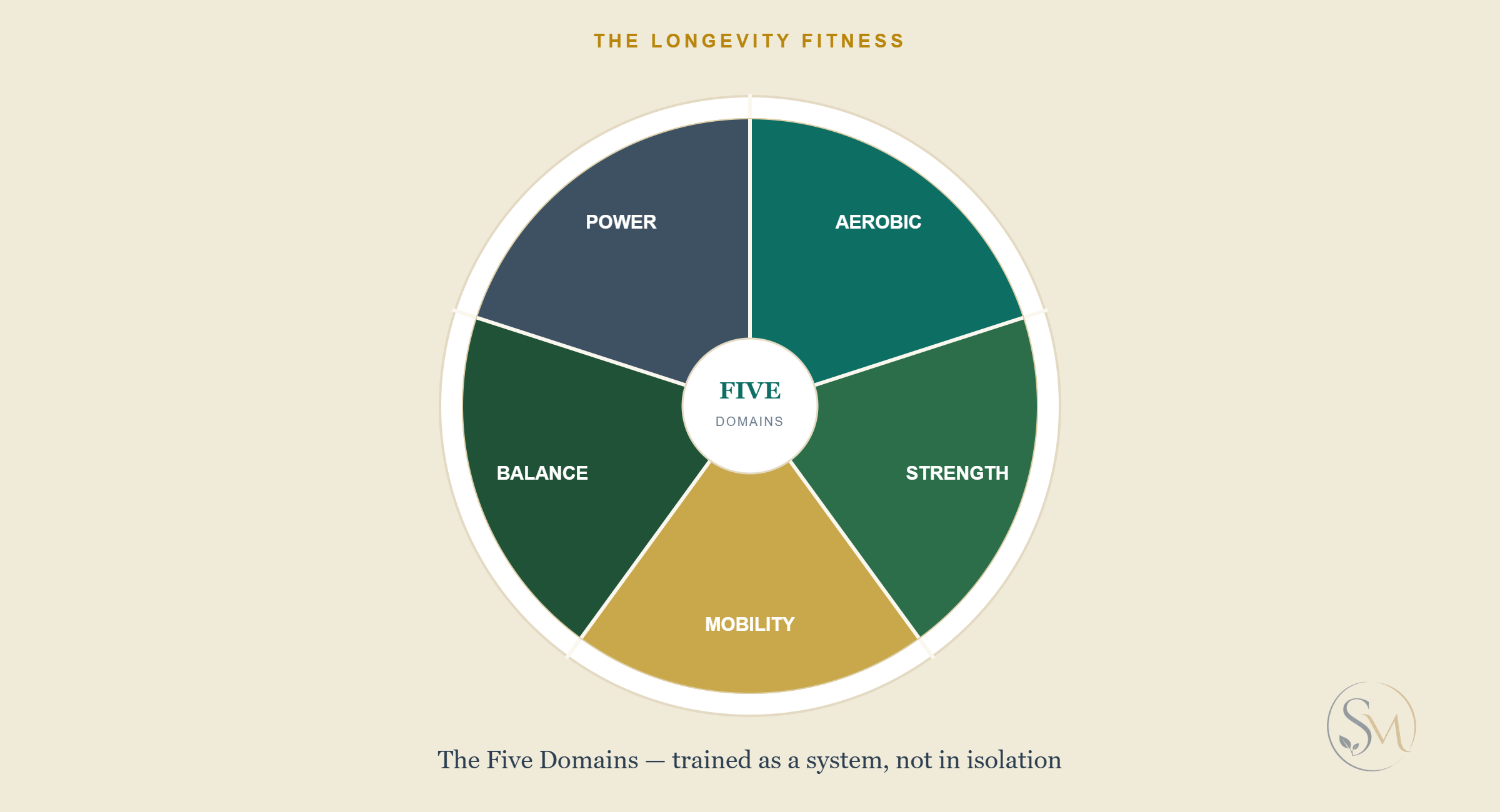
Most people do not have a fitness problem. They have an imbalance problem — years of training (or avoiding) one domain while three or four others quietly go unused. Longevity fitness requires a broader physical portfolio, built on five domains that age independently of one another:
- Aerobic capacity — the ability of the heart, lungs, vessels, and mitochondria to sustain effort.
- Strength and muscle — longevity tissue that helps you rise from chairs, climb stairs, carry groceries, and manage glucose.
- Mobility and flexibility — usable range of motion, not just how far a joint can passively stretch.
- Balance, gait, and coordination — confidence in motion, and independence expressed through walking.
- Power and resilience — the ability to produce force quickly, which preserves the body’s ability to respond to the unexpected.
The body ages as a system, so it has to be trained as a system. Someone who runs for decades but never lifts weight is protecting aerobic capacity while losing strength. Someone who lifts weight but never trains balance is building muscle on top of a foundation that is quietly eroding.
Why “reserve” is the real goal
Reserve is the buffer between what life demands and what the body can do. When reserve is high, daily tasks feel easy — the stairs, the suitcase, the grandchild lifted off the ground without a second thought. When reserve is low, ordinary life becomes close to maximum effort, and small setbacks — a cold, a bad night of sleep, a missed week of training — start to feel disproportionately large.
Aging itself is not only the passing of time. It is the gradual loss of that reserve. Sarcopenia (age-related muscle loss) and dynapenia (loss of strength) can begin before muscle size visibly changes, and power often declines earlier and faster than basic strength — which is exactly why the ability to move quickly and forcefully deserves its own attention, not just endurance and bulk.
The encouraging part: the body remains trainable much longer than most people believe. Older adults can gain strength. Deconditioned people can improve endurance. Balance can improve. Mobility can improve. None of the five domains are fixed by a certain age — they are fixed by whether they are trained at all.
What this looks like in practice
Exercise is not merely calorie expenditure — it is biological instruction. A brisk walk alone asks the heart to pump more efficiently, the vessels to respond to flow, the muscles to use glucose, the mitochondria to produce energy, and the nervous system to coordinate rhythm and balance, all at once. Few interventions cross that many systems simultaneously.
A longevity training week does not need to be complicated. It needs to touch all five domains on a rotating basis: sustained aerobic effort most days, resistance training two to three times a week, deliberate mobility work, balance practice that gets harder as it gets easier, and occasional efforts that ask the body to move with speed and force rather than just steady output.
Why this matters more than appearance
Appearance is not enough. Capability is the deeper goal. A body that looks fit but cannot catch itself on a curb, or carry its own suitcase up a flight of stairs, has not actually built reserve — it has built the appearance of it. The future body is built by the physical signals repeated today, across all five domains, not just the one that happens to be a habit already.
Adapted from The Longevity Fitness, part of the Jawani Longevity Series by Charan Shikh, MD.
From the ShikhMD Library
Continue in Built to Last: The Longevity Blueprint
Explore the bookMedical disclaimer: This article provides general educational information and is not a substitute for individualized medical diagnosis or treatment.