

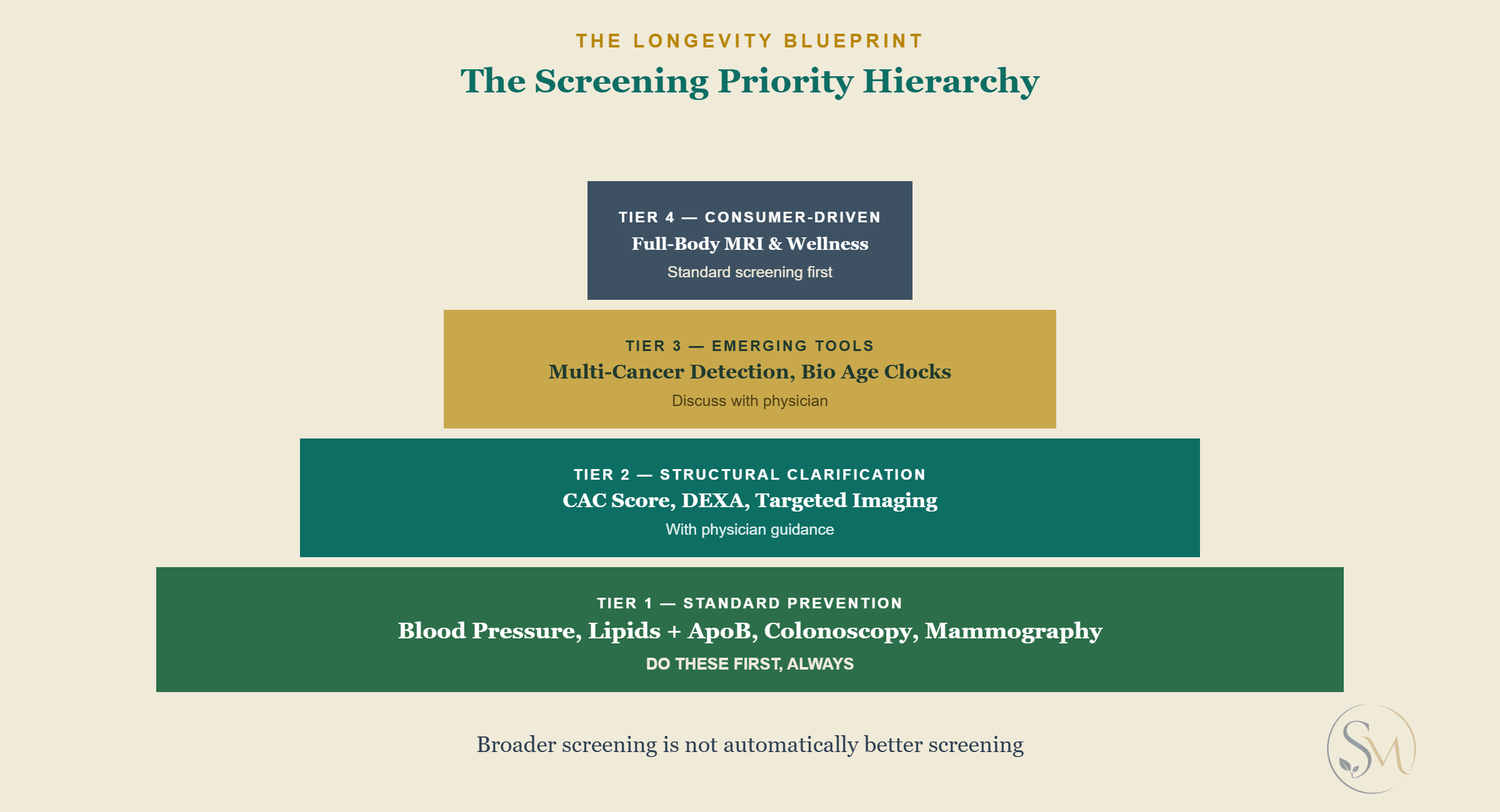
“Broader screening is not automatically better screening.” A test is useful when it improves outcomes more than it creates harm, confusion, or distraction. That single idea is easy to agree with and surprisingly hard to apply — especially now that direct-to-consumer imaging and genetic panels promise to see more than a standard physical ever could.
Standard screening first — always
Before any conversation about advanced or emerging screening technologies, one principle has to be stated clearly: the highest-value screening for most people consists of tools that already have strong mortality-reduction evidence and that are frequently under-utilized. Colonoscopy. Blood pressure measurement. Mammography. Lipid and glucose assessment. Lung CT in appropriate smokers. Skin checks. None of these are exciting. They are evidence-based, and they demonstrably reduce mortality — and plenty of people who spend money on sophisticated imaging packages have not completed their basic screening.
Advanced screening is powerful because it can see earlier. It is risky because seeing more does not always mean helping more. The right question isn’t whether a test can find something — it’s whether finding it early improves outcomes enough to justify the cost, anxiety, follow-up testing, false positives, and incidental findings.
The full-body MRI question, honestly
Full-body MRI attracts enormous interest because it promises comprehensive internal visualization without radiation. The clinical reality is more nuanced than the marketing: no randomized controlled trial has demonstrated a mortality benefit from population-wide full-body MRI screening in asymptomatic adults.
The broader the imaging field, the higher the rate of incidental findings of uncertain significance — findings that trigger further testing, specialist referrals, repeat imaging, and real anxiety without necessarily improving health outcomes. Finding something is not the same as helping someone. Selected individuals over 45 with a strong personal or family history of specific cancers may appropriately benefit — but that decision belongs with a physician who knows the full risk profile, not a consumer scanning service treated as a routine wellness check.
The screening priority hierarchy
- Tier 1 — Standard prevention. Blood pressure, lipid panel with ApoB, fasting insulin, HbA1c, colonoscopy, mammography, skin check, lung CT for smokers. Proven mortality reduction in large randomized trials. Do these first, always.
- Tier 2 — Structural clarification. CAC score for intermediate cardiovascular risk, DEXA for bone and body composition, targeted imaging for specific symptoms. Evidence-supported in the right clinical context, with physician guidance.
- Tier 3 — Emerging tools. Multi-cancer detection tests, extended genomic panels, biological age clocks. Promising, advancing quickly, not yet standard of care — worth discussing with a physician.
- Tier 4 — Consumer-driven. Full-body MRI without a specific indication, executive wellness packages, direct-to-consumer imaging. Not endorsed by clinical guidelines for population-wide use, with a real incidentaloma risk. Complete standard screening first.
Screening becomes clinically meaningful when a result can lead to a clear next step. Before ordering a test, it’s worth asking what finding is being sought, how likely it is in this individual, what follow-up would be required, and whether discovering it earlier is known to improve outcomes. Without those answers, more imaging may create information without creating health.
Why this matters
Standard, evidence-based screening has demonstrated mortality benefit and belongs at the base of every prevention plan — complete it before pursuing anything more advanced. If you’re considering full-body MRI, have that conversation with your physician first, and understand the incidentaloma risk before committing. And if you carry a strong family cancer history, request a referral to a clinical genetic counselor before ordering any specialized imaging or cancer-detection test on your own.
Adapted from Built to Last: The Longevity Blueprint by Charan Shikh, MD.
From the ShikhMD Library
Continue in Built to Last: The Longevity Blueprint
Explore the bookMedical disclaimer: This article provides general educational information and is not a substitute for individualized medical diagnosis or treatment.