

Few changes frighten people more than changes in the mind. Many tolerate weight gain, poor sleep, or reduced physical stamina longer than they should — but difficulty concentrating, mental slowing under stress, or the early fear of cognitive decline carries a different emotional force. The mind isn’t just another organ system. It’s how a person remains recognizable to themselves.
The brain ages inside the body
Cognitive aging is not only a brain problem. It is a vascular problem, a sleep problem, a metabolic problem, an inflammatory problem, and often a social problem. Poor vascular health ages the brain. Poor sleep ages the brain. Insulin resistance ages the brain. Chronic stress, depression, hearing loss, and isolation all age the brain. None of these are separate from cognitive health — they are the upstream inputs that determine the brain’s trajectory.
Protecting cognition therefore begins with ordinary clinical fundamentals: control blood pressure, restore sleep, improve metabolic health, remain physically active, treat hearing loss, and preserve meaningful social connection. Brain health is not only about avoiding dementia — it is about preserving clarity, mood, resilience, and full participation across the entire arc of life.
The 20-year prevention window
Alzheimer’s disease pathology — the accumulation of amyloid-beta and tau proteins in the brain — begins fifteen to twenty years before any clinical symptoms appear. This is one of the most important and most underappreciated facts in all of preventive medicine. It means a 65-year-old receiving an Alzheimer’s diagnosis may have had the pathological process underway since their mid-forties.
The window for meaningful prevention is not after diagnosis. It is now. For many readers, it was a decade ago. The second best time is today.
The five factors with the strongest evidence
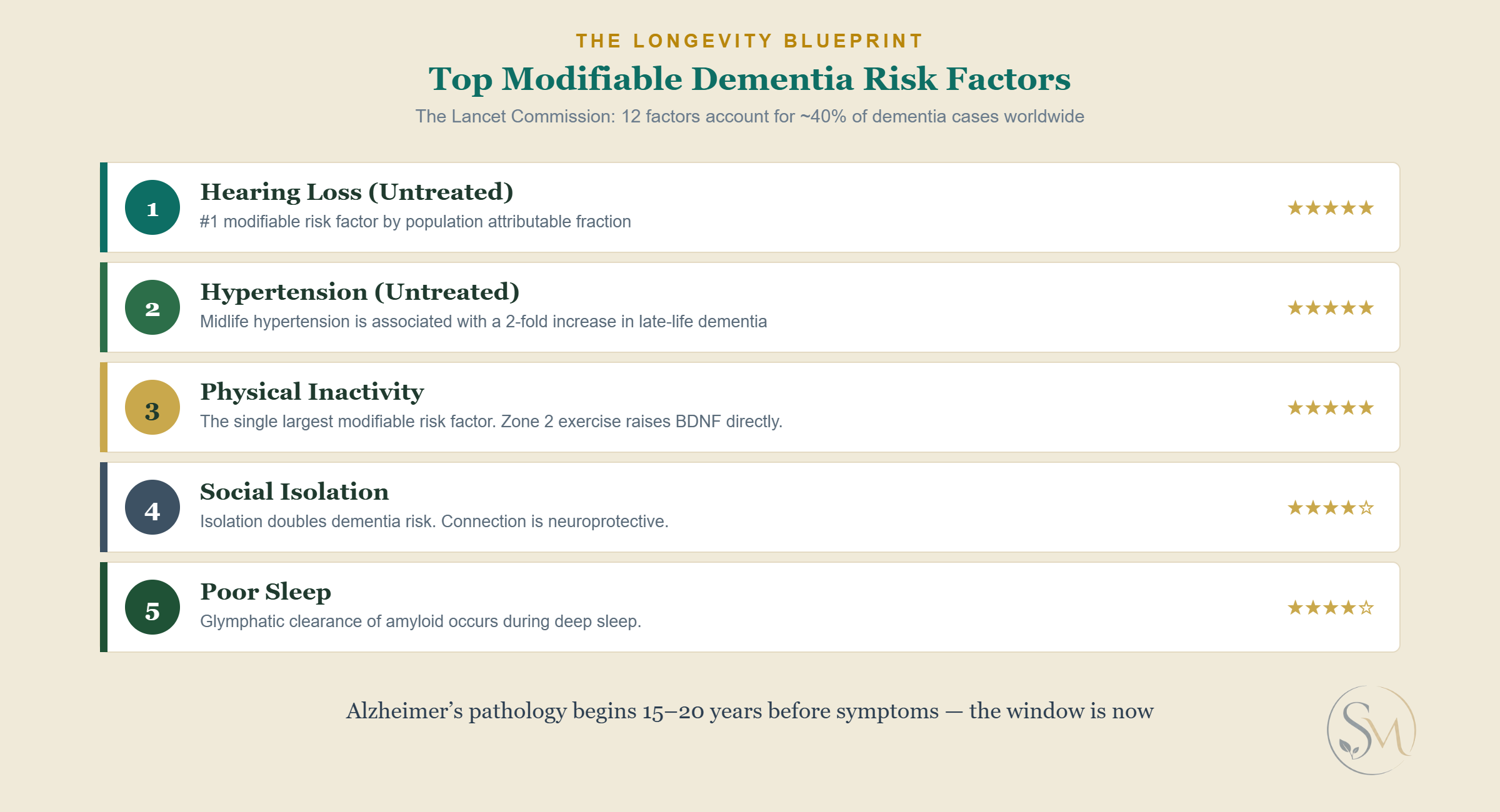
The Lancet Commission on Dementia Prevention identified twelve modifiable risk factors that together account for roughly 40% of dementia cases worldwide. Five stand out for the strength of their evidence:
- Hearing loss (untreated) — the single largest modifiable dementia risk factor by population impact. If you need hearing aids, wear them.
- Hypertension (untreated) — midlife high blood pressure is associated with a two-fold increase in late-life dementia risk.
- Physical inactivity — the strongest replicated finding in the field. Zone 2 aerobic exercise raises BDNF (brain-derived neurotrophic factor) directly — this is neurogenesis you can schedule.
- Social isolation — isolation roughly doubles dementia risk across extensive epidemiologic data.
- Poor sleep — the glymphatic system clears amyloid from the brain during deep sleep; untreated sleep apnea accelerates the risk.
Mood is a longevity variable, not a separate issue
Depression and anxiety are not simply mental health conditions — they are biological states that accelerate the hallmarks of aging. Chronic depression raises cortisol, promotes inflammation, reduces hippocampal volume, impairs sleep, and increases isolation. Untreated depression is not something to manage around. It is something to treat, with measurable positive effects on physical health outcomes as a result.
Brain fog that follows a period of sleep debt, high stress, or a hormonal transition is not a character trait or a permanent shift. It is often a biological state that responds to sleep improvement, hormonal support, metabolic correction, and exercise — sometimes dramatically.
Why this matters
Every ten mmHg reduction in systolic blood pressure measurably reduces dementia risk — making it the highest-impact single intervention available. Pair that with a hearing check, three sessions of Zone 2 exercise this week, and genuine attention to sleep and connection, and you are addressing more dementia risk than any drug currently on the market.
Adapted from Built to Last: The Longevity Blueprint by Charan Shikh, MD.
From the ShikhMD Library
Continue in Built to Last: The Longevity Blueprint
Explore the bookMedical disclaimer: This article provides general educational information and is not a substitute for individualized medical diagnosis or treatment.