

Exercise is not punishment for the body. It is one of the clearest ways to protect the body from becoming smaller, weaker, and less resilient over time. If there were a single intervention in all of medicine that improved cardiovascular health, reversed metabolic syndrome, grew new brain cells, strengthened bones, preserved muscle, and reduced all-cause mortality by 30 to 50% — all at once — it would be considered one of the great discoveries in medicine. It already exists. It’s exercise.
The number that predicts longevity better than almost anything else
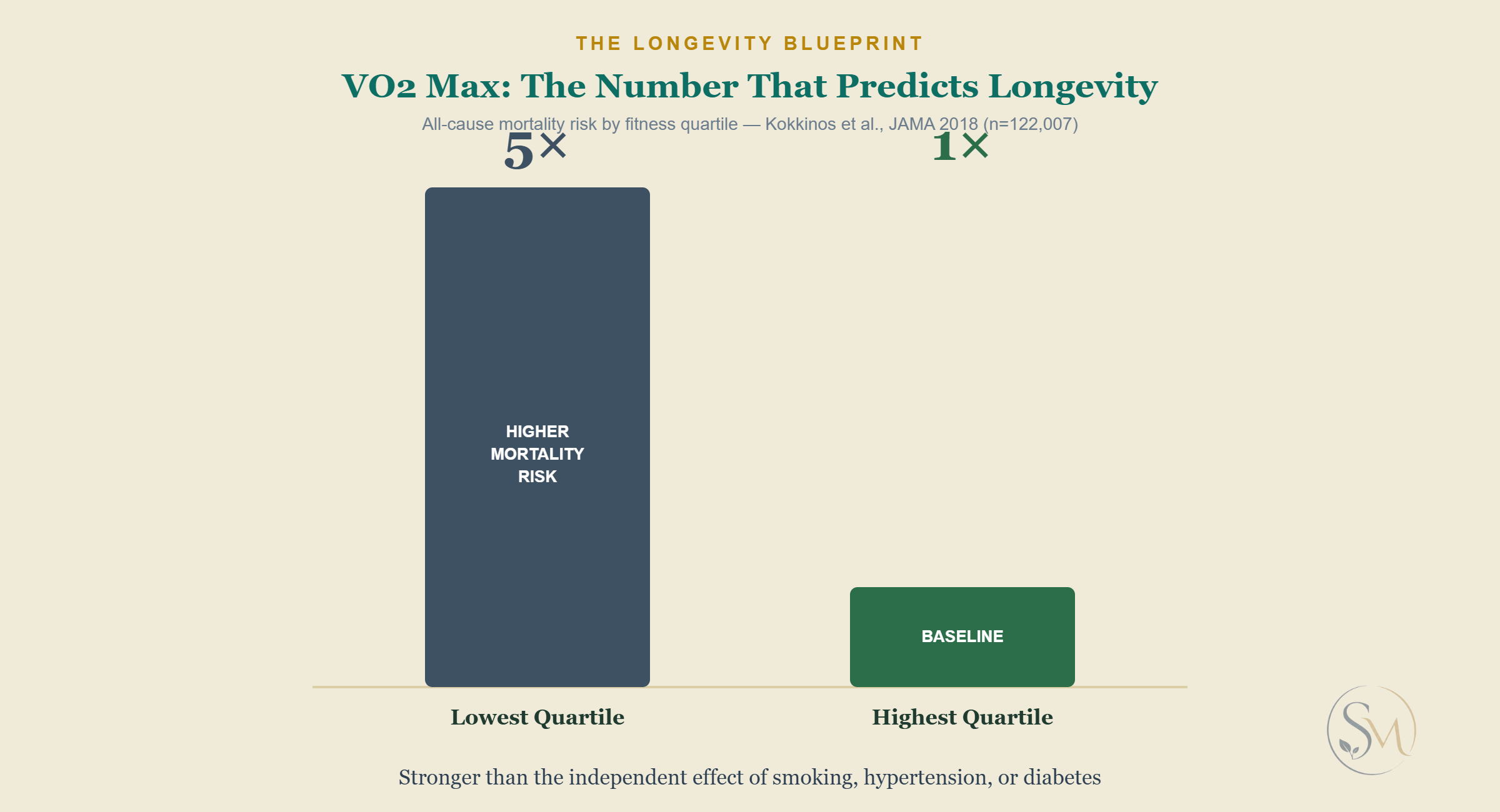
VO2 max — maximal oxygen uptake during exercise — is the single strongest predictor of all-cause mortality available to a clinician. A landmark study published in JAMA (Kokkinos et al., 2018, n=122,007) found that people in the lowest VO2 max quartile had a five-fold higher all-cause mortality risk than those in the highest quartile. That relationship is stronger than the independent effect of smoking, hypertension, or diabetes.
The clinical news here is genuinely good: VO2 max is highly modifiable. Zone 2 cardio combined with high-intensity intervals can meaningfully improve it at any age — including among previously sedentary adults in their sixties and seventies.
The woman who discovered exercise wasn’t optional
A woman in her early sixties thought of exercise as something she should do but had never fully committed to — occasional walks, a few tries at yoga, good intentions that rarely survived the week. When she stopped moving consistently for four months during a stretch of high work stress, nearly everything worsened at once: sleep grew lighter, blood pressure crept up eight points, abdominal weight increased, mood flattened, and joint stiffness intensified.
What was wrong wasn’t mysterious — it was the absence of exercise, not as a cosmetic habit but as a physiological anchor for nearly every system she was trying to preserve. Three Zone 2 sessions a week, forty-five minutes each, at a brisk walking pace, and within eight weeks her sleep had improved, her blood pressure had dropped, and she described the return of what she called “internal resilience.”
The four dimensions, and the weekly protocol
- Zone 2 cardio (foundation) — sustained aerobic activity at 60–70% max heart rate, conversational pace. 150 minutes a week minimum, 180+ for meaningful VO2 max improvement. Builds mitochondrial density, arterial flexibility, and brain blood flow.
- Resistance training (essential) — compound movements: squat, hinge, push, pull, carry. Two to three full-body sessions weekly, with 48 hours of rest between. Addresses sarcopenia, bone density, and insulin sensitivity directly.
- HIIT or sprint work (amplifier) — 85–95% effort in short bursts, followed by full recovery. One to two sessions a week, 15–20 minutes total. Drives VO2 max gains and growth hormone release.
- Mobility & balance (infrastructure) — yoga, stretching, single-leg stands, Tai chi. Daily, 15–30 minutes. Protects joint integrity and prevents the fall that changes everything.
A simple week: Zone 2 on Monday and Wednesday, resistance training Tuesday and Thursday (upper and lower focus), Zone 2 or HIIT on Friday depending on energy, a longer active-recovery session on Saturday, and mobility work on Sunday.
Why this matters
No pharmaceutical compound available today produces this breadth of benefit, and it’s available to every reader at every age. Most modern wearables — Garmin, Apple Watch, Whoop, Polar — estimate VO2 max automatically. Establish your baseline this week, and start with three 45-minute Zone 2 sessions. Not next month. This week.
Adapted from Built to Last: The Longevity Blueprint by Charan Shikh, MD.
From the ShikhMD Library
Continue in Built to Last: The Longevity Blueprint
Explore the bookMedical disclaimer: This article provides general educational information and is not a substitute for individualized medical diagnosis or treatment.