

Most people think of cardiovascular disease in terms of dramatic events — heart attacks, strokes, emergency rooms, urgent procedures. But the vascular story usually begins long before any of those crises. It begins quietly, through rising blood pressure, arterial stiffness, inflammation, and the gradual accumulation of burden inside the vessels that supply every organ the body depends on.
The quiet story that begins long before crisis
The vessels do not complain early. They adapt silently to pressure, inflammation, glucose burden, nicotine, poor sleep, and stress for years before symptoms appear. People feel entirely normal while the vascular system is being exposed to chronic strain — and by the time a crisis arrives, the groundwork has been laid for a long time. That silence is exactly why prevention matters: cardiovascular longevity depends on treating risk before the body turns it into an event.
The most important number in longevity medicine
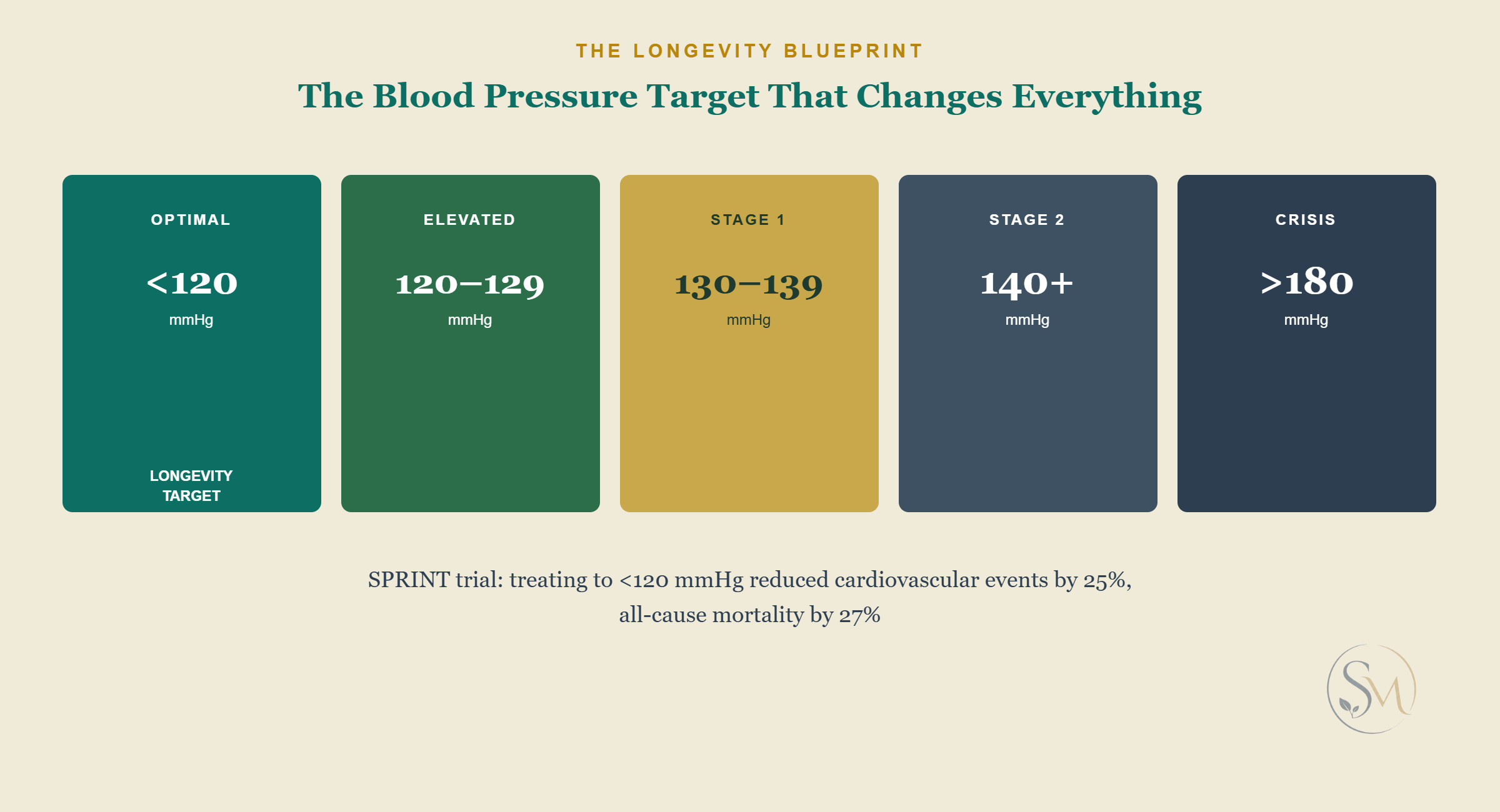
Of all the modifiable risk factors for cardiovascular mortality, stroke, cognitive decline, and heart failure, blood pressure control has the strongest and most replicated evidence. The SPRINT trial demonstrated that treating systolic blood pressure to below 120 mmHg — rather than the conventional 140 mmHg target — reduced cardiovascular events by 25% and all-cause mortality by 27%. That is a larger effect than most single medications produce.
- Optimal (longevity target): under 120 mmHg — associated with the lowest cardiovascular and cognitive aging trajectory
- Elevated: 120–129 mmHg — lifestyle modification urgently indicated, and often reversible
- Stage 1 Hypertension: 130–139 mmHg — treatment discussion required; organ risk begins here
- Stage 2 Hypertension: 140+ mmHg — medication typically required alongside lifestyle change
- Hypertensive Crisis: above 180 mmHg — emergency evaluation required
The biomarker LDL doesn’t tell you
The standard lipid panel — total cholesterol, LDL, HDL, and triglycerides — has been the cornerstone of cardiovascular risk assessment for decades. But it has a real limitation: LDL measures cholesterol mass, not the number of particles carrying that cholesterol. It’s the particles that embed in artery walls, not the weight of cholesterol they carry.
ApoB directly counts the number of atherogenic particles. A person can have a relatively low LDL but a high ApoB — many small, dense particles — and carry significantly higher cardiovascular risk than their LDL alone would suggest. This is precisely the pattern seen in insulin resistance and metabolic syndrome, which is why ApoB matters most alongside fasting insulin. The longevity target for ApoB is under 80 mg/dL, well below the standard “normal” cutoff of 100.
The test that changes the conversation
The Coronary Artery Calcium (CAC) score measures calcium deposits in the coronary arteries using a low-radiation CT scan. It’s one of the most clinically powerful tools for reclassifying cardiovascular risk in people who fall in the intermediate range — where the decision about statin therapy is genuinely uncertain.
A CAC score of zero in someone over 45 is associated with very low ten-year cardiovascular risk, and many clinicians will defer statin therapy in this group. A score above 100 often shifts the treatment conversation significantly, even in people with relatively modest traditional risk factors. The test costs roughly $100–150, is not universally covered by insurance, and provides information a standard blood panel simply cannot.
Why this matters
Cardiovascular disease begins decades before the crisis — which means the window for intervention is long, but only if you’re looking. Blood pressure below 120 mmHg systolic is the single most evidence-supported modification available in cardiovascular longevity, and it costs nothing but attention. One more signal worth knowing: erectile dysfunction before age 60 is primarily a vascular signal. Treat the vessels, and function often follows.
Adapted from Built to Last: The Longevity Blueprint by Charan Shikh, MD.
From the ShikhMD Library
Continue in Built to Last: The Longevity Blueprint
Explore the bookMedical disclaimer: This article provides general educational information and is not a substitute for individualized medical diagnosis or treatment.