

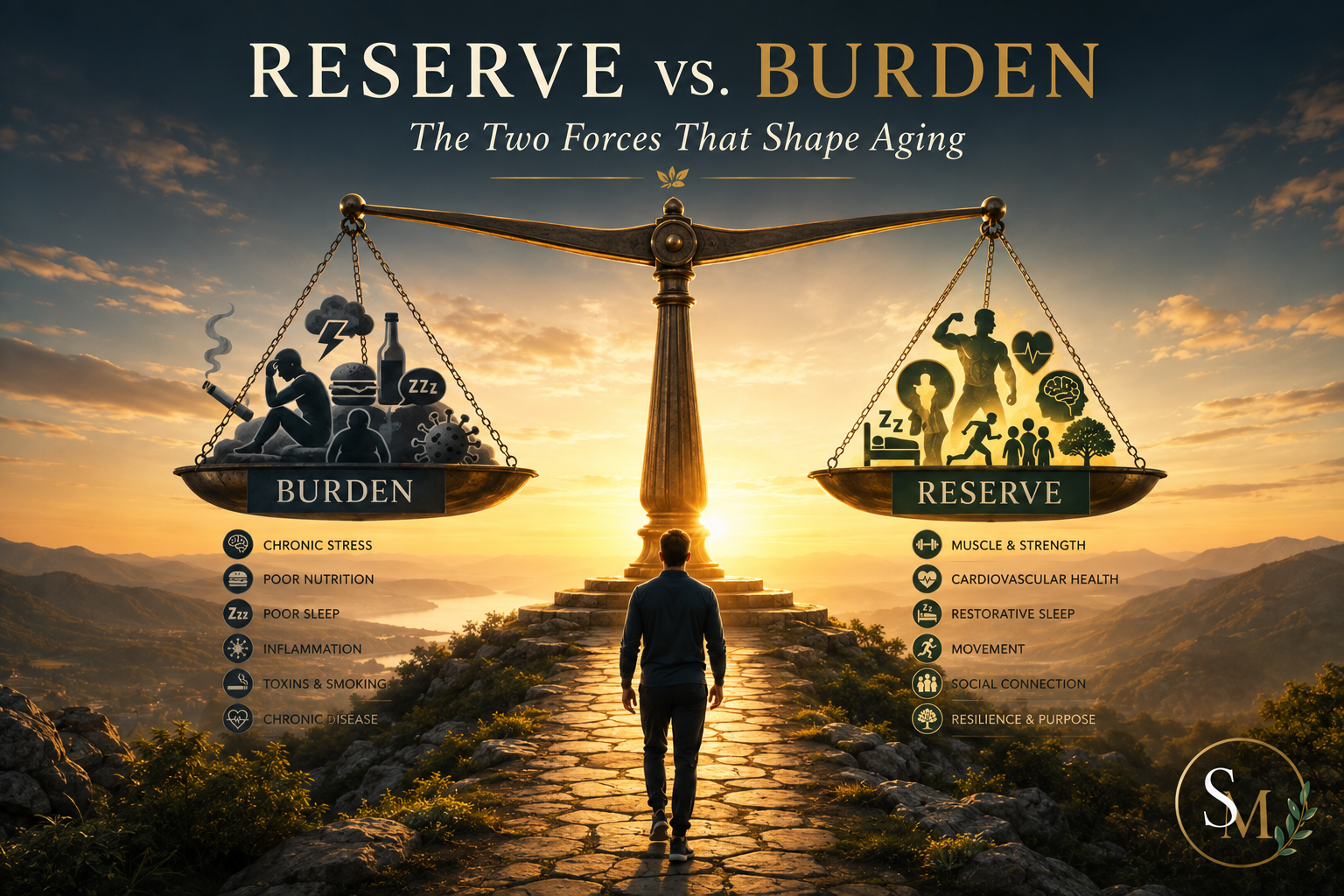
Reserve is what the body can carry. Burden is what the body is being asked to carry. Healthy aging depends on the balance between those two forces.
The two forces that shape aging
Reserve is the body’s and mind’s capacity to tolerate stress, illness, disruption, and the ordinary demands of life without disproportionate decline. A person with high reserve can absorb a poor night of sleep, travel, illness, or a demanding week and recover predictably. A person with depleted reserve is pushed into prolonged fatigue, functional loss, or instability by the same event.
Burden is everything the body is being asked to carry. Poor sleep is a burden. Central fat is a burden. Chronic stress is a burden. Smoking is a burden. Inactivity is a burden. Isolation is a burden. Untreated blood pressure, metabolic dysfunction, and medications that are no longer meaningfully reviewed can all add to burden.
Aging is not only decline; it is shrinking margin
Many people notice aging first as a loss of buffering. Recovery takes longer. A disrupted night affects several days. A minor illness causes a deeper setback. Travel feels harder. Exercise becomes easier to lose and harder to rebuild.
This does not always mean disease has appeared. It often means the margin between capacity and demand has narrowed.
What builds reserve
- Regular aerobic activity
- Strength and muscle preservation
- Restorative sleep
- Metabolic stability
- Healthy blood pressure and vascular function
- Social connection and purpose
- Consistent nutrition and adequate protein
- Confidence in movement, balance, and recovery
Reserve is not one laboratory value. It is the accumulated capacity of multiple systems working well enough to protect function when life becomes demanding.
What increases burden
- Chronic sleep debt
- Visceral or central fat
- Smoking and excess alcohol exposure
- Persistent psychological stress
- Untreated hypertension or metabolic disease
- Low muscle mass and inactivity
- Social isolation
- Overcomplicated or poorly reviewed medication regimens
Burden is cumulative. Each factor may look manageable in isolation, but the body experiences the total load.
Why the same stress affects people differently
The same illness, surgery, travel schedule, or emotional stressor can produce very different outcomes. The difference is often reserve. A person with stronger cardiovascular, muscular, metabolic, cognitive, and social reserve has more capacity available before function begins to narrow.
This is why prevention is not only about avoiding disease. It is also about increasing the body’s ability to tolerate what cannot be avoided.
Reduce burden and build reserve simultaneously
The most effective longevity strategies usually work on both sides of the equation. Exercise builds cardiovascular and muscular reserve while reducing metabolic burden. Better sleep improves recovery, appetite regulation, cognition, and hormonal signaling while reducing stress burden. Smoking cessation reduces vascular and pulmonary burden while improving future reserve.
The goal is not to eliminate every burden. That is impossible. The goal is to create enough reserve that ordinary disruption no longer consumes the entire system.
How to identify your largest burden
Begin with the factors that have the greatest effect on several systems at once. Ask:
- Am I consistently sleeping well enough to recover?
- Is central weight increasing?
- Have strength and aerobic capacity declined?
- Is blood pressure controlled?
- Is stress repeatedly disrupting sleep, eating, or exercise?
- Am I socially connected and engaged?
The highest-value starting point is often the burden that weakens several pillars simultaneously.
How to know reserve is improving
Reserve becomes visible in ordinary life:
- faster recovery after poor sleep or travel,
- more stable energy across the day,
- greater confidence with stairs, walking, and lifting,
- less time lost after illness or stress,
- better tolerance of demanding weeks,
- and fewer days spent feeling physiologically depleted.
The clearest sign of progress is a wider margin between what life demands and what the body can handle.
A practical starting plan
- List your three largest current burdens.
- Choose the burden that affects the most systems.
- Select one reserve-building action that can be repeated reliably.
- Track one real-life outcome, such as sleep continuity, walking pace, blood pressure, or recovery time.
- Add the next layer only after the first becomes stable.
This article provides general educational information and is not a substitute for individualized medical diagnosis or treatment.
From the ShikhMD Library
Continue in Built to Last: The Longevity Blueprint
Source chapters: Chapter 2: The Longevity Blueprint Framework.
Explore the bookMedical disclaimer: This article provides general educational information and is not a substitute for individualized medical diagnosis or treatment.