

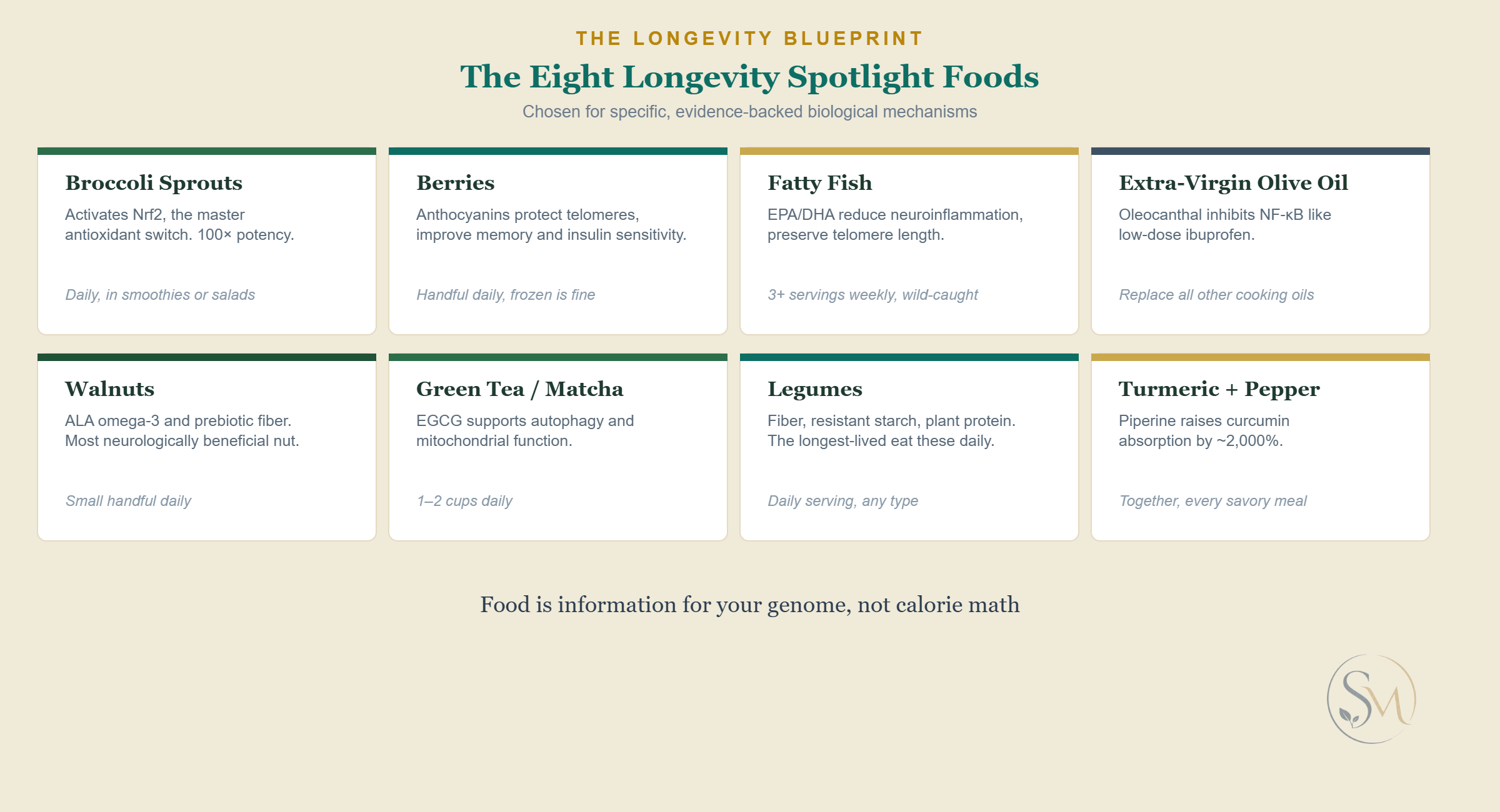
Food is not only fuel. It is information for your genome. No single meal determines your trajectory, but the pattern created across hundreds of meals becomes one of the strongest biological signals the body receives. The best longevity diet isn’t the most extreme one — it’s the most evidence-supported pattern a person can actually repeat without feeling punished by it.
What the science actually shows
The Mediterranean dietary pattern consistently ranks as the best-studied, most replicated, and most clinically validated dietary approach for longevity. The landmark PREDIMED trial — a randomized controlled trial of 7,447 participants at high cardiovascular risk — found that the Mediterranean diet, supplemented with extra-virgin olive oil or nuts, reduced cardiovascular events by roughly 30%. That’s a larger benefit than most single medications produce, delivered entirely through food.
It isn’t a rigid prescription. It’s a framework: abundant vegetables, legumes, whole grains, olive oil, fish, and fruit; moderate dairy; minimal red meat and ultra-processed food. Not low-fat. Not low-carb. An anti-inflammatory, polyphenol-rich, fiber-dense pattern that addresses several hallmarks of aging at once.
The eight longevity spotlight foods
- Broccoli sprouts — sulforaphane activates the Nrf2 pathway, the body’s master antioxidant switch. About 100× more potent than mature broccoli; add to smoothies or salads daily.
- Berries (any type) — anthocyanins protect telomeres and improve memory and insulin sensitivity. Frozen works just as well as fresh, and is often more affordable.
- Fatty fish — salmon, sardines, mackerel. EPA/DHA reduce neuroinflammation and preserve telomere length. Aim for three-plus servings a week; sardines are the most nutrient-dense and least expensive option.
- Extra-virgin olive oil — oleocanthal inhibits NF-κB, the master inflammatory switch, with activity comparable to low-dose ibuprofen. Replace other cooking oils with it entirely.
- Walnuts — the most neurologically beneficial nut in the evidence base, via ALA omega-3s and prebiotic fiber. A small daily handful is enough.
- Green tea or matcha — EGCG supports autophagy and mitochondrial function. One to two cups daily.
- Legumes — lentils, black beans, chickpeas. Fiber, resistant starch, and plant protein that support microbiome diversity. The longest-lived populations in the world eat legumes daily.
- Turmeric + black pepper — curcumin inhibits NF-κB; piperine from black pepper increases its absorption by roughly 2,000%. Use them together at savory meals.
When you eat matters as much as what you eat
Time-restricted eating — condensing daily intake into an 8-to-10-hour window — activates AMPK, suppresses mTOR, and supports autophagy even without reducing total calories. This isn’t caloric restriction; it’s temporal restriction, and the evidence supports a meaningful metabolic benefit.
The most sustainable starting point is a 14:10 window: stop eating at 7 PM, eat again at 9 AM. That’s a 14-hour overnight fast most people can hold without feeling deprived. From there, a 16:8 window offers stronger AMPK activation for anyone working on metabolic correction specifically.
Why this matters
The eight spotlight foods work through specific, identifiable biological mechanisms — not through calorie math. Pick one to add this week rather than trying to overhaul everything at once: broccoli sprouts in a morning smoothie, or sardines twice this week. Replace your default cooking oil with a good extra-virgin olive oil. Then count your plant foods for a week — most people land in the single digits, and the target that correlates with the longest-lived populations is thirty per week, spices included.
Adapted from Built to Last: The Longevity Blueprint by Charan Shikh, MD.
From the ShikhMD Library
Continue in Built to Last: The Longevity Blueprint
Explore the bookMedical disclaimer: This article provides general educational information and is not a substitute for individualized medical diagnosis or treatment.