

Sleep is one of the most underestimated pillars of healthy aging. Most people know they feel worse when they sleep badly, but still treat sleep as negotiable — a comfort issue, a scheduling problem, a personality trait of those who happen to prioritize it. A longevity framework has to challenge that directly. Sleep is not a luxury. It is one of the body’s primary repair environments, and it is where biology does some of its most irreplaceable work.
The repair environment you cannot skip
A tired body does not repair as efficiently, regulate appetite as cleanly, think as clearly, or train as effectively. Sleep is the biological reset that makes the rest of a longevity plan possible — which is why it has to be treated as infrastructure, not as a reward for finishing everything else.
Poor sleep does not only make a person feel tired. It drives insulin resistance, raises blood pressure, elevates cortisol, suppresses growth hormone release, disrupts appetite regulation, impairs glymphatic brain clearance, accelerates cellular aging, reduces testosterone, and fragments emotional regulation. Someone who exercises regularly, eats well, and takes targeted supplements but consistently sleeps six hours or less is undermining most of what they are trying to accomplish.
The man who accepted poor sleep as aging
A man in his late fifties had accepted poor sleep as part of getting older. He woke repeatedly through the night, snored heavily, depended on caffeine to function in the morning, felt mentally foggy by mid-afternoon, and was slowly gaining abdominal weight despite eating the same way he always had. He thought of these as separate inconveniences.
What he hadn’t connected was that a single underlying condition — obstructive sleep apnea — was likely driving most of them simultaneously. When it was diagnosed and treated with a CPAP device, he described the following six months as feeling like he had aged backwards. Poor sleep is rarely only about feeling tired.
What sleep actually does
Deep slow-wave sleep handles glymphatic brain clearance of amyloid and tau, growth hormone release, tissue repair, and memory consolidation — lose it, and the risks include accelerated Alzheimer’s-related change and poorer memory. REM sleep handles emotional processing, synaptic pruning, and mood regulation. Even total sleep duration on its own governs hormonal regulation, immune function, and appetite — which is why fragmenting sleep across the night can undermine the same systems as simply not sleeping enough.
The optimization protocol that actually moves the needle
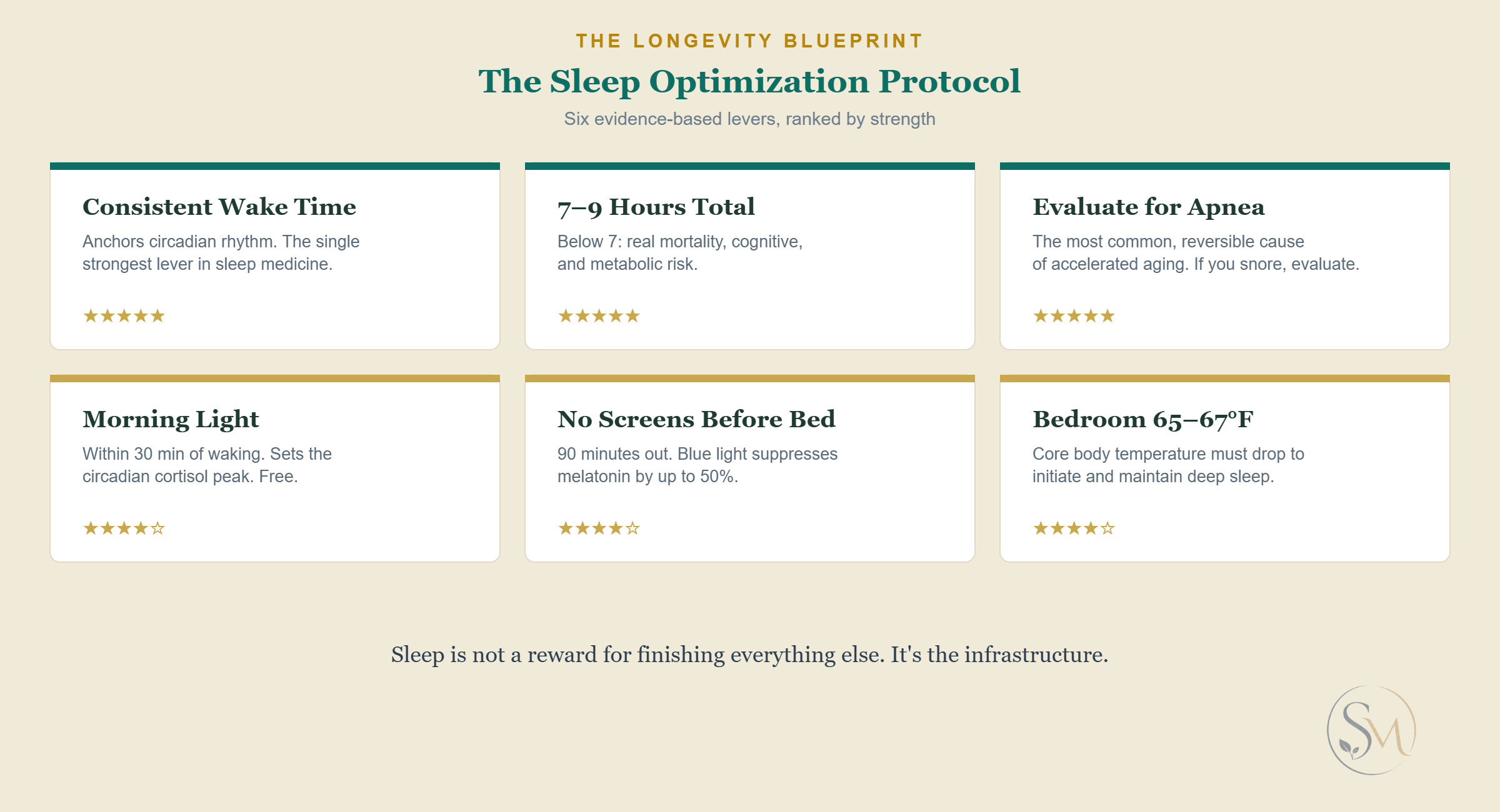
- Consistent wake time, every day. The single strongest lever in sleep medicine — anchors the circadian rhythm, and it’s free.
- Sleep 7–9 hours total. Below seven hours carries real, dose-dependent mortality, cognitive, and metabolic risk. Six hours with “adaptation” is not the same as six hours of safety.
- Evaluate for sleep apnea. The most common, most under-diagnosed, and most aggressively reversible cause of accelerated aging. If you snore, get evaluated.
- Morning light within 30 minutes of waking. Sets the circadian cortisol peak and downstream melatonin timing — free and powerful.
- No screens 90 minutes before bed. Blue light suppresses melatonin by up to 50% and delays sleep onset by 30–60 minutes.
- Bedroom temperature 65–67°F. Core body temperature has to drop one to two degrees to initiate and sustain deep sleep.
Why this matters
Sleep is the primary maintenance window for brain health, hormonal regulation, metabolic function, and physical repair — it is not negotiable, and it does not average out over a week of catching up on weekends. Of everything on this list, consistent wake time costs nothing and is available to everyone tonight.
Adapted from Built to Last: The Longevity Blueprint by Charan Shikh, MD.
From the ShikhMD Library
Continue in Built to Last: The Longevity Blueprint
Explore the bookMedical disclaimer: This article provides general educational information and is not a substitute for individualized medical diagnosis or treatment.